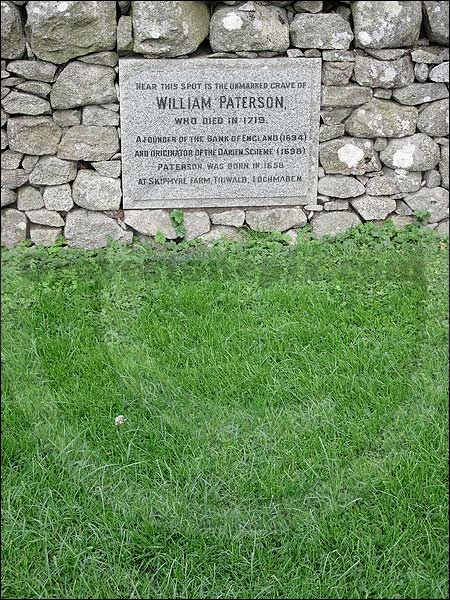
Sir William Paterson is buried in an unmarked grave at Sweetheart Abbey, near to Dumfries in Scotland.

As the founder of the Bank of England, he is also recognised as one of the key players in the creation of the global banking system we have today.
Born in April 1658 at Skipmyre, Tinwald, it is thought he was educated at Lochmaben.
Aged just 17 and with a yearning to explore, he journeyed south to England and after a short time travelled to America via the port at Bristol.
Whilst in the Bahamas the history of William Paterson becomes cloudy, with some commentators saying he may have become a buccaneer or even a preacher.
Whichever way the story goes, he returned to Scotland a wealthy man with some influence.
Darien Scheme
Given the economic hold on profitable trade routes across the Atlantic by the English, to the legal exclusion of the Scots, William Paterson set about trying to find ways to gain back trade to Scotland, with or without the blessing of the Westminster Parliament.
The project became known as the Darien Scheme, with William Paterson convinced that Scotland’s fortune could be made in Central America.
Darien is an area near to Panama. The area was chosen to be a trading hub between the Atlantic trade routes and the Pacific colonies.
Although the scheme failed and almost bankrupted Scotland, the concept of a trade route avoiding the treacherous seas off Cape Horn was correct. As a result, the Panama Canal was built, saving ships many days at sea and the dangerous seas of the southern oceans.
Founder of the Bank of England
As King William and Queen Mary came to the throne in 1688, national finances were weak and in much disarray.
Looking towards the Dutch, and their system of credit based finance, many considered this to be the only way forward. However, it was William Paterson who tabled the accepted scheme based upon public investment.
William Paterson proposed a loan of £1,200,000 to the Government. In return the subscribers would be incorporated as the Governor and Company of the Bank of England.
Within a few weeks the capital sum had been raised and the Royal Charter was sealed.
The Bank of England was founded on the 27 July 1694 to act as the Government’s banker and debt-manager. It started life with 17 clerks and 2 gatekeepers.
William Paterson died 22 January 1719.
Only one portrait is thought to exist of the founder of modern finance, a pen and ink drawing from 1708. It currently hangs in the British Museum.
Further information about Sir William Paterson
http://www.nndb.com/people/625/000096337/
Darien Venture – BBC
The Darien Scheme 1698 – BBC video
Electric Scotland – William Paterson